Celebrations
Planning a Naples beach proposal that feels seamless
A beach proposal fails in one of two ways. The light is gone, or there are forty people walking behind you. Both are decided weeks before the day, and both are entirely fixable.
Choose Via Miramar for privacy and time the moment 45 to 60 minutes before sunset rather than at sunset. Proposing as the sun touches the water means proposing in falling light with the best photographic window already spent. The setup is finished and waiting before you arrive, so there is nothing to assemble in the moment.
When should you propose on a Naples beach?
Forty-five to sixty minutes before sunset. That is the answer, and it is not the answer most people arrive with. The instinct is to aim for the moment the sun touches the water, which is the single most common proposal timing mistake we see.
The reason is straightforward once you look at the numbers. Sunset in Naples ranges from 5:40 p.m. at the December solstice to 8:22 p.m. in late June[1], and by the time the sun is actually touching the horizon the light is dropping fast. Proposing an hour ahead puts the moment in warm low light that is still bright enough to photograph cleanly.
The moment itself takes about two minutes. The hour around it is what you keep. Timing it early means the whole of that hour is usable rather than half of it. The full breakdown of how sunset moves through the year is in our guide to timing a setup to the sunset.
The three windows, and what each one gives you
The evening breaks into three distinct blocks, and they are not interchangeable. Knowing which one you are proposing in is the difference between photographs you frame and photographs you explain.
- 45 to 60 minutes before sunset: warm low light, still bright, faces lit rather than silhouetted. This is where the proposal belongs.
- At sunset: dramatic and fast-falling. Beautiful, harder to shoot, and over quickly.
- After sunset: civil twilight runs 23 to 27 minutes past the listed sunset in Naples[1]. Soft, colourful, no shadows. A better time to sit than to propose.
The practical sequence that works: propose in the first window, celebrate through the second, and sit in the third. The setup is there for all of it, and cleanup is ours, so nothing about the evening has an administrative end.
Choosing the quietest access point
Via Miramar is the access we recommend for proposals, and it is not close. Residential access and the lightest foot traffic of the three beaches we work most often mean far fewer people crossing the background at the exact wrong second.
The trade is the walk. Parking is residential street parking, so the carry is longer than at 3rd Avenue South. That is irrelevant when the group is two people and we have already carried everything.
- Via Miramar: lightest foot traffic, cleanest background, best for privacy.
- 5th Avenue South: convenient for dinner afterwards, most people passing behind.
- 3rd Avenue South: shortest carry, best if a group is joining to celebrate after.
The full comparison on crowd, access and light is in our guide to the best beaches in Naples for a setup.
Deciding who else is there
A proposal with a photographer hidden nearby is a different plan from a proposal with nobody else present. Both work well. They need different arrangements, and the decision has to be made before the day rather than on it.
If a photographer is coming, they need a position and a sightline established before you arrive. That is much easier to build the setup around than to move afterwards, and it is the main reason to tell us in advance rather than treat it as a detail.
If nobody else is present, the setup is finished and empty when you walk up. No one is waiting, no one is watching, and nothing needs explaining.
If family are joining to celebrate afterwards, give them a time at least 30 minutes past the moment. People arrive early when they are excited, and a group appearing over the dune mid-proposal is the one failure mode that cannot be recovered.
Getting her to the beach without giving it away
The cover story is the part people improvise, and it is the part most likely to fail. The setup is invisible until you are almost on top of it, which helps, but the reason for being at a beach at a specific time still needs to hold up.
What works reliably is a reason that is true. Dinner reservations at a specific time in town, with a walk beforehand. A sunset you have been meaning to watch. Meeting friends who are, as it happens, running late. Each of these survives a follow-up question because none of them is invented.
What fails is an unusually specific instruction with no reason attached, particularly around clothing. Being told what to wear for a casual walk is the single most common tell, and it is worth solving by choosing an occasion that naturally justifies it rather than by insisting.
Arrival timing helps too. If you arrive 90 minutes before sunset for a setup timed to 45 minutes before, there is a comfortable hour of simply being there first. Nothing about the pacing feels staged, because it is not.
Rings, sand and the things that actually go wrong
Sand gets into everything, and a ring is small. This sounds like a joke until it is four people on their knees at dusk, which has happened to people who were not us and which we would like nobody to repeat.
Two habits prevent it entirely. The ring stays in a closed box or a zipped pocket until the moment, never loose in a hand and never resting on a chair arm. And it comes out over the table or over a towel rather than over open sand.
Beachwear frequently has no usable pockets, which is worth checking rather than discovering. If there are none, the box travels in the bag that is already coming, and the bag stays within reach rather than being set down somewhere sensible and then forgotten.
The table in every setup exists partly for this. It gives you a surface that is not the ground, at the exact moment you need one. It is a small thing that removes a real risk, and it is one of several reasons a styled setup beats a towel and good intentions.
What the setup looks like for two
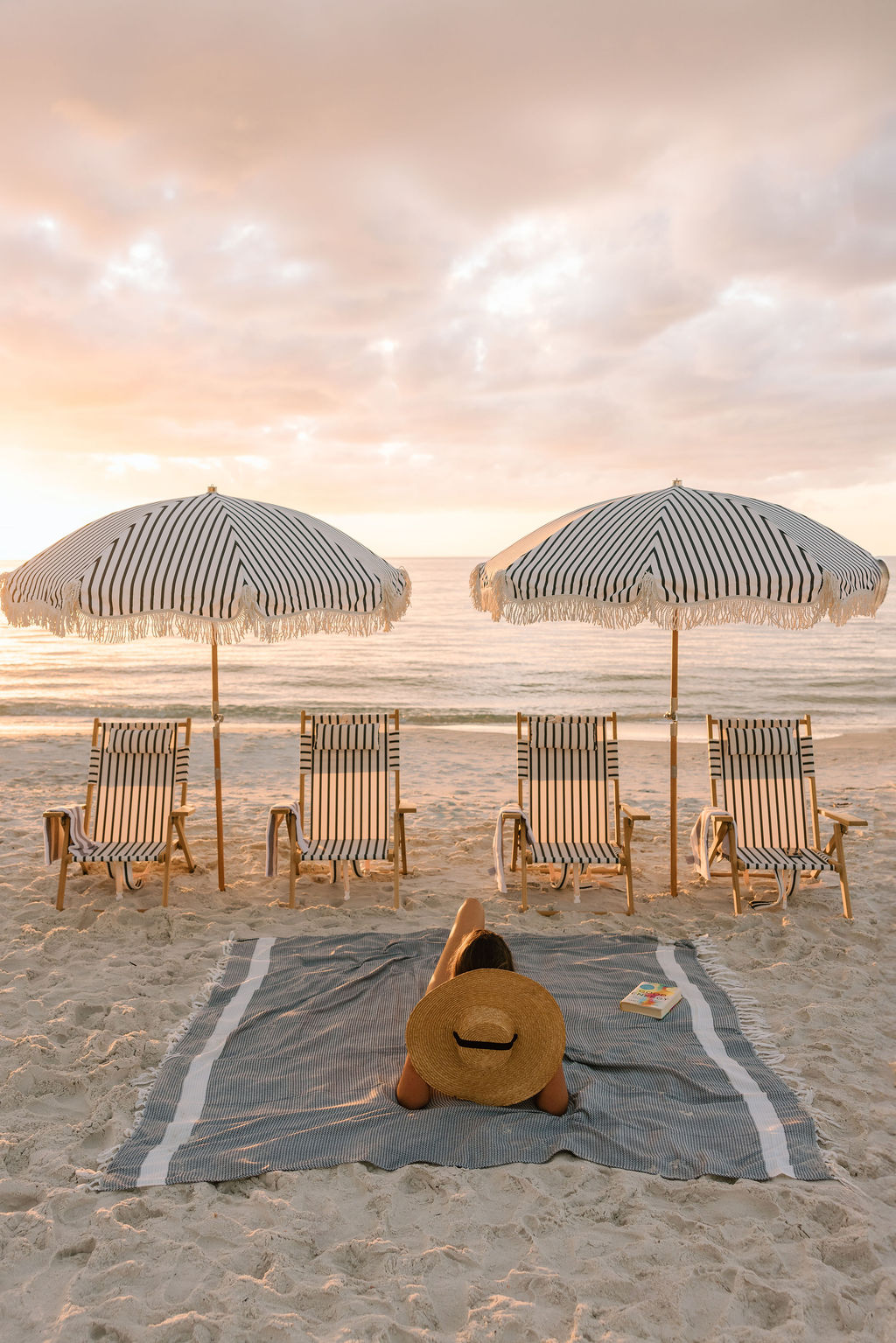
A two-person setup is arranged differently from a group one. Both chairs angled west toward the water, a low table between them, shade placed and angled rather than planted, and nothing else in the frame.
Every setup includes comfortable chairs, real shade, soft towels, a side table, a cooler packed with ice and water, and a speaker, with delivery, setup and cleanup included. For a proposal the styling matters more than usual, because the photographs are the entire point rather than a by-product.
The Double Date package is the two-hour styled setup for two, timed to the sunset for your date. Details are on the beach setup packages in Naples page, and there are examples of how two-person setups are arranged in the gallery.
The rules that catch proposals out
Alcohol without written approval is prohibited on City of Naples property, and glass is prohibited outright.[3] A bottle of champagne and two flutes on the sand is the exact image most people have in mind, and it is the exact thing the rules do not allow.
The workable version is a toast at a restaurant either side of the beach block, or written approval sought in advance. Glass has no workaround at all, including stemware, on a surface people walk barefoot across.
Tell us the plan when you check your date. It is a far better conversation at booking than a beach patrol officer arriving thirty seconds after the ring comes out.
Weather, and why a bad forecast is not a lost evening
A completely clear sky is not the best proposal sky. Colour needs something to land on, and scattered high cloud produces both the strongest colour and the longest afterglow, because cloud catches light from a sun already below the horizon.
Through summer the southwest Florida pattern is its own kind of reliable. Afternoon convection builds inland and frequently clears toward the coast by early evening. A menacing three o'clock does not mean a lost seven-thirty, and we would rather talk it through on the day than cancel on a morning forecast.
Solar position for any given date can be checked independently against the Solar Calculator[2] if you want to confirm the timing yourself rather than take ours.
Sea turtle nesting season and evening setups
From roughly May through October the Naples beaches are active nesting habitat. Nests incubate around 60 days, so hatchlings emerge into the autumn[4], and obstacles left on the sand overnight can block a nesting female or disorient hatchlings.
The framework is state level. Section 161.163, Florida Statutes directs designation of coastal nesting areas[5], and Florida DEP publishes the Chapter 62B-55, Model Lighting Ordinance for Marine Turtle Protection that coastal governments adopt for beachfront lighting.[6] Lighting restrictions along the shoreline after dark are the part most relevant to an evening proposal.
Collier County guidance is that beach furniture comes off each night, with penalties for furniture left after 9:30 p.m. under the Land Development Code. We could not load the county's page directly to quote it verbatim, so treat the exact time as guidance to confirm rather than a quoted code section.
For a proposal timed to the light this is never a constraint. Removal is included on every setup.
Practical things that go wrong, and how to avoid them
The failures we see are almost never about the setup. They are small logistical things that nobody planned for because the planning went into the moment itself.
- Arriving separately and losing each other. Agree a meeting point away from the beach, not on it.
- A phone that dies before the photographs. Heat drains batteries faster than people expect, and the good window is short.
- Pockets. Beachwear frequently has none. Decide where the ring is travelling before you leave.
- Sand. Do not put a ring box down on it, for reasons that become obvious immediately.
None of these are our department, which is exactly why they are worth listing. Everything that is our department is already done before you arrive.
Making the photographs count
The window that produces the photographs people frame is roughly 45 minutes long, and it does not repeat. Everything about the timing recommendation on this page exists to put the proposal inside it rather than after it.
If you have hired a photographer, the position matters as much as the timing. Shooting west into the sun silhouettes both of you, which some couples want and most do not expect. Shooting from the west with the sun behind the camera lights faces properly. Tell them which you want before the day.
If you are relying on a friend, give them one job and a specific place to stand. A friend who is also emotionally invested and also holding a drink is not a reliable second camera. And whoever is shooting, check the phone or camera is charged, because heat drains batteries faster on a beach than people plan for.
Examples of how two-person setups are arranged and how they photograph across the three beaches are in the gallery.
Turning the proposal into the rest of the evening
Decide in advance what the evening becomes, because the half hour after is not the moment to be making plans. There are three shapes and each needs a different booking.
- Just the two of you, staying: book the longer block. There is a cooler packed and nothing to pack down, and civil twilight runs 23 to 27 minutes past sunset[1].
- Dinner in town: choose 5th Avenue South so it is a walk, and book the table at least 45 minutes after the listed sunset rather than 15.
- Family joining to celebrate: give them a time at least 30 minutes past the moment, and consider 3rd Avenue South for the shorter carry if several people are coming.
Whichever shape it takes, the removal is ours. During nesting season the sand has to be clear overnight[4], and that obligation sits with us rather than with you at the end of the evening you have just spent months planning.
Booking the date, and how far ahead
Book as soon as the date is fixed. January through April is high season in Naples and weekend dates go first. If the proposal is tied to an anniversary or a visit, the date is not movable, so the booking should not wait.
Outside high season availability is easier, but the timing question gets harder rather than simpler, because sunset moves so much. A November date booked in September is the classic trap: sunset drops 61 minutes overnight when the clocks change, from 6:46 p.m. on 31 October to 5:45 p.m. on 1 November[1].
Give us the date rather than a time when you request your date, and we will work the arrival back from the real sunset for that day.
What happens after you say yes
The half hour after is the part people forget to plan, and it is frequently the best part of the evening. Civil twilight is still running, the light is soft, and the two of you have somewhere to sit that is already set up.
If family or friends are joining, this is when. If dinner is booked, put it at least 45 minutes after the listed sunset rather than 15, or you will be leaving during the best light. 5th Avenue South is the access that makes dinner a walk rather than a drive, though at the cost of privacy earlier.
If it is just the two of you, stay. There is a cooler packed and nothing to pack down. Cleanup and removal are ours, so the evening ends when you decide it does rather than when the logistics do.
Why the setup being finished matters more than it sounds
Nothing about the setup should require you to do anything in the moment. That is the whole design, and it is worth saying plainly because it is the difference between a proposal and a proposal you also project-managed.
The setup is complete before your arrival window opens. Shade placed and angled, seating arranged, cooler packed and cold, table styled. You walk up to a finished scene with nobody around it.
The alternative, assembling your own, means arriving early, building it while watching for her, and then removing it afterwards, during nesting season under a nightly deadline. People do it. Almost nobody enjoys it, and the photographs show the difference.
Other occasions we set up for are on the beach celebrations page, and more planning guides are in the journal.

Andrea
Founder, Make My Beach Day · Naples, Florida
Andrea founded Make My Beach Day and has been styling and setting up beach days on the Naples coastline since the company started. The timings in this guide come from running setups across every month of the year on 3rd Avenue South, 5th Avenue South and Via Miramar, checked against published astronomical data rather than memory. Talk to Andrea about your date.
Andrea
Founder, Make My Beach Day
Tap a question to ask
References
- US Naval Observatory, Astronomical Applications Department. Sun and Moon Rise/Set Table for One Year. Sunset and twilight times computed for Naples, Florida (26.14°N, 81.79°W).
- NOAA Global Monitoring Laboratory. Solar Calculator. Independent cross-check for solar position and sunset timing.
- City of Naples. Beach Patrol. City of Naples beach rules and enforcement.
- Florida Fish and Wildlife Conservation Commission. Sea turtles and beach activities. State guidance on beach activity during marine turtle nesting season.
- Florida Legislature. Section 161.163, Florida Statutes. Directs designation of coastal areas used by marine turtles for nesting.
- Florida Department of Environmental Protection. Chapter 62B-55, Model Lighting Ordinance for Marine Turtle Protection. The state model ordinance local governments adopt for beachfront lighting.
Ready to book your beach day?
Tell us the date and the plan and we will time the setup to the light.
Book your beach day