Planning
The best time for a sunset beach setup in Naples
Sunset in Naples is not a fixed time, and the gap is bigger than most people plan for. On 21 December the sun sets at 5:40 p.m. On 21 June it sets at 8:22 p.m. That is a swing of 2 hours and 42 minutes across the same calendar year, which is why a setup booked for "around seven" is perfect in late March and an hour into darkness in December.
Arrive 90 minutes before sunset. That buys roughly 45 minutes of open light, then the 30 to 40 minutes of low golden light that actually photographs, then 25 minutes of civil twilight afterglow once the sun is down. Look up your date's real sunset time first, because in Naples it moves by nearly three hours across the year.
What time is sunset in Naples, Florida?
Sunset in Naples ranges from 5:40 p.m. at the winter solstice to 8:22 p.m. at the summer solstice. That is a swing of 2 hours and 42 minutes. Civil twilight, the usable afterglow once the sun is below the horizon, adds a further 23 to 27 minutes on top of the sunset time.[1]
Those are not estimates. They are computed for Naples' coordinates from the US Naval Observatory rise and set service[1], and cross-checked against the NOAA Global Monitoring Laboratory solar calculator[2]. The reason they matter commercially is simple: a booking made in April for a November date, timed by memory rather than by the almanac, lands an hour late.
| Date | Sunset | Civil twilight ends | Why it matters |
|---|---|---|---|
| 2026-03-20 | 7:38 p.m. | 8:01 p.m. | Spring equinox |
| 2026-06-21 | 8:22 p.m. | 8:49 p.m. | Summer solstice, latest sunset of the year |
| 2026-09-22 | 7:23 p.m. | 7:46 p.m. | Autumn equinox |
| 2026-10-31 | 6:46 p.m. | 7:10 p.m. | Last evening of daylight saving time |
| 2026-11-01 | 5:45 p.m. | 6:09 p.m. | First evening after the clocks change |
| 2026-12-21 | 5:40 p.m. | 6:06 p.m. | Winter solstice, earliest sunset of the year |
Two things fall out of that table immediately. The first is the sheer size of the annual swing. The second is the single overnight jump between 31 October and 1 November, which we come back to below because it catches more bookings than anything else in the year. If you already have a date, you can check your date and we will work the timing back from it.
The 90-minute arrival window, and the arithmetic behind it
Arrive 90 minutes before sunset. The window breaks into three parts: about 45 minutes of open, bright light; then 30 to 40 minutes of low golden light; then roughly 25 minutes of civil twilight afterglow after the sun has gone.[1] An hour is not enough, because an hour means you spend the golden portion settling in rather than sitting in it.
The civil twilight figure is the part almost nobody books for, and it is measurable. On 21 June 2026 the sun sets at 8:22 p.m. and civil twilight ends at 8:49 p.m., which is 27 minutes of usable light after sunset. On 21 December sunset is 5:40 p.m. and civil twilight ends at 6:06 p.m., 26 minutes later.[1] The afterglow window is remarkably stable across the year even though the sunset time is not.
In practice the last 20 minutes of that window produce a large share of the photographs people keep. The sky holds colour, the light is soft and directionless, and faces stop squinting. If you are planning planning a beach proposal, this is the part of the evening to protect.
Because we deliver, set up and clean up, your 90 minutes is not spent assembling anything. That is the entire point of the arrival window: it exists for you, not for logistics. You can see how the setups are arranged in the gallery.
Sunset by month in Naples: a booking table
Use the month you are booking, not the season. March alone moves sunset by nearly an hour and twenty minutes, because daylight saving time begins partway through it. November does the same in reverse. Every other month drifts gently.
| Month | Sunset range | Arrive |
|---|---|---|
| January | 5:45 p.m. - 6:05 p.m. | 4:15 - 4:35 p.m. |
| February | 6:05 p.m. - 6:20 p.m. | 4:35 - 4:50 p.m. |
| March | 6:25 p.m. - 7:45 p.m. | 4:55 - 6:15 p.m. |
| April | 7:45 p.m. - 8:00 p.m. | 6:15 - 6:30 p.m. |
| May | 8:00 p.m. - 8:15 p.m. | 6:30 - 6:45 p.m. |
| June | 8:15 p.m. - 8:22 p.m. | 6:45 - 6:52 p.m. |
| July | 8:10 p.m. - 8:20 p.m. | 6:40 - 6:50 p.m. |
| August | 7:50 p.m. - 8:10 p.m. | 6:20 - 6:40 p.m. |
| September | 7:20 p.m. - 7:50 p.m. | 5:50 - 6:20 p.m. |
| October | 6:45 p.m. - 7:20 p.m. | 5:15 - 5:50 p.m. |
| November | 5:35 p.m. - 6:45 p.m. | 4:05 - 5:15 p.m. |
| December | 5:35 p.m. - 5:45 p.m. | 4:05 - 4:15 p.m. |
The two volatile months are March and November, and both are volatile for the same reason: the clocks. Everything between April and October moves by 30 minutes or less across the whole month, so a time set at the start of the month still works at the end of it. That is not true in March or November.
If you are choosing a month rather than working to a fixed date, March through May is the strongest combination on the calendar. Sunset is late enough for a proper evening booking, the temperatures sit below peak summer, and the sky is generally clearer than it is in the storm season. It is also the busiest window in Naples, so those weekends book earliest, which is the main reason to book a sunset beach setup early for spring dates rather than close in. The beach setup packages in Naples are the same year round.
The November cliff: when sunset drops 61 minutes overnight
On 31 October 2026 the sun sets in Naples at 6:46 p.m. The following evening it sets at 5:45 p.m.[1] Nothing about the sun changed. The clocks did. That is a 61-minute drop between one evening and the next, and it is the single most common timing mistake we see.
The mistake has a specific shape. Someone books in September or early October, when sunset is comfortably in the seven o'clock hour, and sets a time from experience. The date falls in mid or late November. By then sunset is in the five o'clock hour, and a setup timed for 6:30 p.m. is a setup in the dark.
The rule to apply is narrow and it works: if your date is within a week of the clock change in either direction, confirm which side of it you are on before you fix a time. Outside that window, the monthly table above is close enough to book from.
There is a second consequence that matters more in winter than people expect. Once sunset is at 5:40 p.m., the whole evening compresses. A 4:10 p.m. arrival is a mid-afternoon arrival, which changes what the day looks like around it: lunch beforehand rather than dinner afterwards, and a shorter, brighter block on the sand. When you request your date, tell us the shape of the day you want and we will work the timing backwards from the sunset for your actual date.
Civil twilight: the 25 minutes most people do not book for
Civil twilight is the period after sunset when the sun is up to six degrees below the horizon and there is still usable natural light. In Naples it runs 23 to 27 minutes depending on the date.[1] Most people treat sunset as the end of the evening. It is closer to the middle of the good part.
What changes in that window is the quality of the light rather than the quantity. Direct sun is gone, so there are no hard shadows and nobody is squinting into the west. The sky takes on colour it did not have ten minutes earlier. Skin tones go warm and even. If there is high cloud, this is when it lights up.
The practical implication for a booking is that the block should not end at sunset. If you have a dinner reservation, put it at least 45 minutes after the listed sunset time rather than 15, or you will be packing up during the best light of the evening. We do the packing up either way, so the only thing at stake is whether you are still sitting there for it. It is also the window that decides most of what ends up in the gallery.
Sea turtle nesting season and the 9:30 p.m. rule
Naples beaches sit inside a protected sea turtle nesting area, and that governs what can be left on the sand after dark. Nesting runs roughly May through October, with nests incubating about 60 days and hatchlings emerging into the autumn, per the Florida Fish and Wildlife Conservation Commission.[6] During that period, obstacles left on the beach overnight can block nesting females and disorient hatchlings.
The framework is state level. Section 161.163 of the Florida Statutes directs the designation of coastal areas used by marine turtles for nesting[3], and the Florida Department of Environmental Protection publishes the Chapter 62B-55 model lighting ordinance that coastal local governments adopt for beachfront lighting.[4] FWC's ordinance directory lists which counties and municipalities have adopted one.[5]
Locally, Collier County's public guidance is that beach furniture comes off the beach each night, with furniture left out after 9:30 p.m. subject to penalties under the Land Development Code. Collier County's own public guidance states that beach furniture should be removed from the beach each night and that furniture left out after 9:30 p.m. is subject to penalties under the Collier County Land Development Code. We were unable to load the county's page directly to quote it verbatim at the time of writing, so treat the exact time as county guidance to confirm rather than a quoted code section. The underlying state framework is cited above.
For a sunset booking this is almost never a constraint, because the arithmetic works out. Even at the latest sunset of the year, 8:22 p.m. on 21 June, civil twilight has ended by 8:49 p.m.[1] An evening that ends with the light ends comfortably before the deadline. It matters most for anyone planning to stay on well after dark in summer, and it is a genuine reason to book a setup that includes removal rather than assembling your own and leaving it.
Cleanup and removal are included on every one of our beach setup packages, so compliance is handled as part of the service rather than being something you have to remember at the end of an evening.
How weather changes the sunset you actually get
A completely clear sky produces a reliable sunset, not the best one. Colour needs something to land on. Scattered high cloud is what produces the sky people picture when they book a sunset setup, and it also extends the afterglow, because cloud catches light from a sun that is already below the horizon.
Through the summer months the pattern in southwest Florida is its own kind of predictable. Afternoon convection builds inland through the heat of the day and frequently clears toward the coast by early evening. A menacing 3 p.m. does not mean a lost 7:30 p.m., and we would rather talk it through on the day than cancel a booking on a morning forecast.
Three broad conditions and what each gives you:
- Clear: a clean horizon line and a reliable drop, with a shorter colour window.
- Scattered high cloud: the strongest colour and the longest afterglow.
- Low overcast: soft, even, flattering light with no colour. Better for portraits than most people assume.
Heat is a separate question from light, and in summer it is the one that decides whether an afternoon block is comfortable. We cover that in shade, timing and the Gulf breeze, along with how shade placement changes as the sun tracks west.
What a sunset setup includes, and what decides the cost
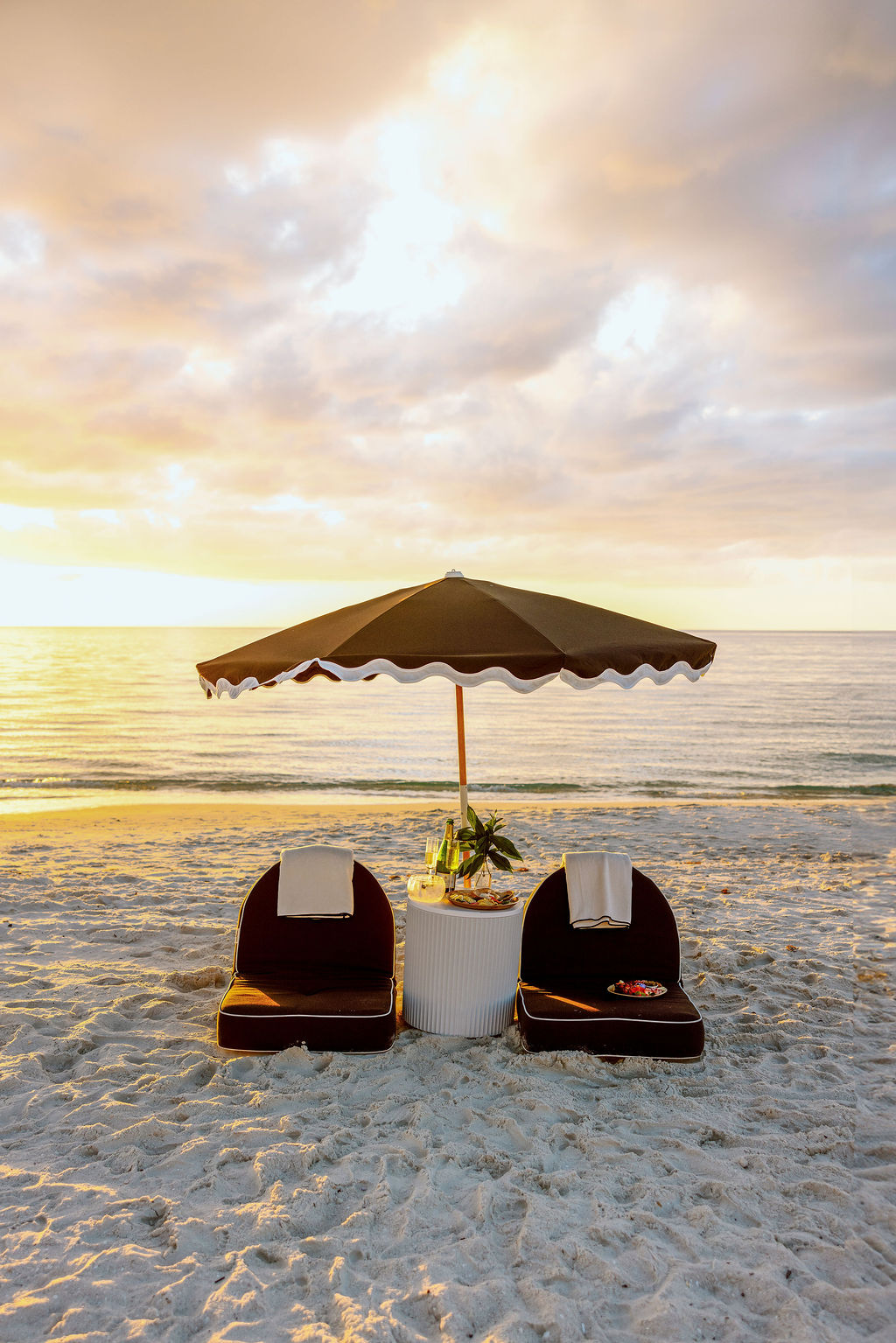
Every setup arrives complete before you do. Comfortable chairs, real shade from an umbrella or cabana, soft towels, a side table, a cooler packed with ice and water, a Bluetooth speaker, and the styled details that make the scene photograph. Delivery, setup and cleanup are included on every package, in every season.
Two package shapes cover most sunset bookings. The Double Date is a two hour styled setup for two, timed to the sunset for your date. The Beach Day scales for a group, with fringe umbrellas and seating arranged for the party rather than lined up facing out. Both are described in full on the beach setup packages in Naples page.
Four things move what a sunset setup costs, and none of them are surprises if you know them in advance:
- Group size. Seating and shade scale with the headcount, so an accurate number matters more than a rounded one.
- Block length. A 90 minute sunset window is a different build from a four hour afternoon that runs into sunset.
- Season. January through April is peak season in Naples and weekend dates in that window are the first to go.
- Beach and access point. Carry distance from parking affects the setup, which is part of why the access point is worth choosing deliberately rather than by default.
The one thing that does not vary is the removal. Because cleanup is included on every package, an evening booking comes off the sand well inside the nightly window described above, without you having to think about it.
Worth knowing when you compare options: a setup you assemble yourself is not only the carrying and the packing down, it is also the removal deadline landing on you at the end of an evening you wanted to be in. That is the part guests consistently tell us they had not thought about until they had done it once. The whole reason the arrival window works is that none of it is yours to manage.
Booking a sunset beach setup in Naples
Three decisions set the evening: the date, the beach, and the arrival time. The date fixes the sunset. The sunset fixes the arrival. The beach decides what the evening feels like.
On the beach itself, the three access points we work most often each suit a different evening. Via Miramar is the quietest and the one we recommend when the setup is the whole point. 5th Avenue South puts you within walking distance of dinner. 3rd Avenue South has the shortest carry from parking, which matters with a group. There is a fuller comparison in our guide to the best beaches in Naples for a setup.
Everything structural is already on the sand before you arrive: chairs, real shade, towels, a side table, a cooler packed with ice and water, and a speaker. The short list of what is worth bringing yourself is in what to bring. Delivery, setup and cleanup are included on every package.
When you request your date, give us the date rather than a time, and we will work the timing back from the real sunset for that day. More planning pieces are collected in the journal.

Andrea
Founder, Make My Beach Day · Naples, Florida
Andrea founded Make My Beach Day and has been styling and setting up beach days on the Naples coastline since the company started. The timings in this guide come from running setups across every month of the year on 3rd Avenue South, 5th Avenue South and Via Miramar, checked against published astronomical data rather than memory. Talk to Andrea about your date.
Andrea
Founder, Make My Beach Day
Tap a question to ask
References
- US Naval Observatory, Astronomical Applications Department. Sun and Moon Rise/Set Table for One Year. Sunset and civil twilight times in this article are computed for Naples, Florida (26.14°N, 81.79°W) from the USNO rise/set service.
- NOAA Global Monitoring Laboratory. Solar Calculator. Independent cross-check for solar position and sunset timing.
- Florida Legislature. Section 161.163, Florida Statutes — coastal areas utilized by marine turtles. The statute directing designation of coastal areas used by sea turtles for nesting.
- Florida Department of Environmental Protection. Chapter 62B-55, Model Lighting Ordinance for Marine Turtle Protection. The state model ordinance local governments adopt for beachfront lighting.
- Florida Fish and Wildlife Conservation Commission. Sea Turtle Protection Ordinances. FWC's directory of adopted local sea turtle lighting ordinances.
- Florida Fish and Wildlife Conservation Commission. Sea turtles and beach activities. State guidance on beach activity during nesting season.
Ready to book your beach day?
Tell us the date and we will work the timing back from the real sunset for that day.
Book your beach day