Planning
What to bring to your Naples beach setup
The short version is that you should arrive carrying almost nothing. Everything structural is on the sand before you get there. What is worth bringing is the small set of things that are personal, perishable, or genuinely yours to carry.
Bring sunscreen, sunglasses, a hat, a light layer for after sunset, and any drinks beyond the water we pack, within the rules for your beach. Leave chairs, umbrellas, towels, the cooler, the table and the speaker to us. Bringing your own beach gear to a styled setup creates the exact pile the setup exists to avoid.
What is already on the sand when you arrive
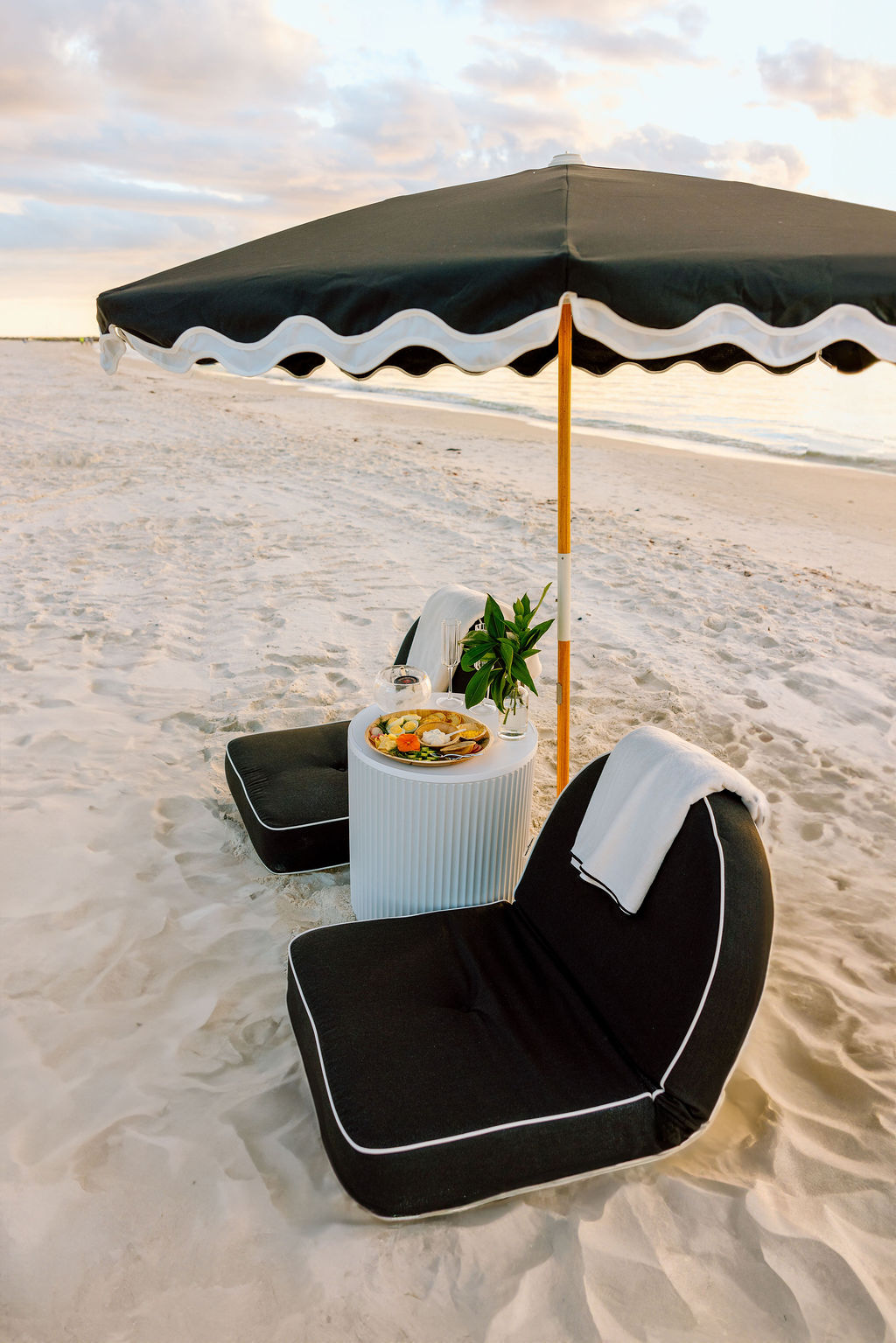
Every setup includes the same core, on every package, in every season. Comfortable beach chairs arranged for your group size, real shade from an umbrella or cabana, soft towels, a side table, a cooler packed with ice and water, and a Bluetooth speaker.
Delivery, setup and cleanup are included every time. That is not an add-on and it is not seasonal. It is the reason the arrival window exists for you rather than for logistics.
The styled details are the part that is hard to describe on a list and obvious in a photograph. Shade placed and angled to the sun rather than planted vertically, seating arranged so a group faces each other rather than lined up at the horizon, and the small things on the table that make the scene read as intentional. There are examples across all three beaches in the gallery, and the full package descriptions are on the beach setup packages in Naples page.
Sunscreen, and what the federal guidance actually says
Bring sunscreen and bring more than you think. The CDC sun safety guidance recommendation is broad-spectrum sunscreen at SPF 15 or higher, applied before going outside, then reapplied after two hours and after swimming, sweating or towelling off.[1]
Two of those triggers are easy to miss on a beach. Towelling off removes sunscreen, which people rarely account for, and the Gulf breeze evaporates sweat before anyone registers that they are sweating at all. The practical version is a two-hour reminder rather than a judgement call.
The Ultraviolet (UV) Radiation and Sun Exposure guidance runs alongside it: seek shade, wear protective clothing and UV-blocking sunglasses, and reduce time in the sun through the middle of the day.[3] Shade is the part we handle. The rest is a bottle in a bag.
Understanding the UV index before you pick a time
The EPA UV Index scale runs from 1 to 11+, and the categories are worth knowing because they change what a reasonable block length is.[2]
- 0 to 2, green: low risk for the average person.
- 3 to 5, yellow: moderate risk from unprotected exposure.
- 6 to 7, orange: high risk.
- 8 to 10, red: very high risk.
- 11 or more, purple: extreme risk.
Southwest Florida sits in the upper half of that scale for much of the year, and the sun is strongest between 10 a.m. and 4 p.m.[2] A block that starts after four avoids the worst of it without giving up any of the good light, since sunset in Naples runs as late as 8:22 p.m. in June[5]. The timing detail is in our guide to timing a setup to the sunset.
The genuinely short list
Five things, and the list is short on purpose. These are the items that are personal, perishable, or that you would rather choose yourself.
- Sunscreen. Broad-spectrum, SPF 15 or higher, per CDC guidance.[1]
- Sunglasses and a hat. UV-blocking sunglasses specifically, not decorative ones.
- A light layer. The single most forgotten item. More on this below.
- Any drinks beyond water, within the rules for your beach.
- A camera or phone, and someone willing to actually use it.
That is it. Everything else on a normal beach packing list is already there, and bringing a duplicate of it makes the setup worse rather than better.
The light layer nobody brings
The Gulf breeze turns cool faster than people expect once the sun is down. This is the most consistent omission we see, and it is the one that ends an evening early.
The mechanism is simple. The onshore breeze that made the afternoon comfortable does not stop at sunset, but the solar heating does. Civil twilight in Naples runs 23 to 27 minutes past sunset[5], and that afterglow window is frequently the best light of the evening. It is also when people in swimwear start deciding they are ready to leave.
A single light layer per person buys that window back. It is the cheapest possible upgrade to a beach evening and it costs nothing to pack.
What to leave at home
Bringing your own beach gear to a styled setup creates the pile the setup exists to avoid. It also crowds the frame in every photograph, which is the part people notice afterwards rather than at the time.
- Chairs, umbrellas and shade structures. All provided, and ours are placed and angled rather than planted.
- Your own cooler, unless it holds something specific we are not packing.
- Beach towels. Soft towels are included.
- Bulky bags. There is a table, and shade to leave things under.
- Anything glass. Prohibited on City of Naples property, and a genuinely bad idea where people walk barefoot.[4]
Alcohol and glass: the rules people get wrong
Alcohol without written approval is prohibited on City of Naples property, and glass is prohibited outright.[4] This catches out more celebration bookings than any other rule, because a bottle of something on the sand is exactly the picture people have.
The workable versions are to plan the toast for a restaurant either side of the beach block, or to seek written approval in advance rather than assuming. What does not work is bringing it and hoping. The beaches are patrolled, and being asked to pack up mid-celebration is a memorable way to end an afternoon.
Glass has no workaround at all. No bottles, no stemware, nothing that breaks. If a drink is part of the plan it is a plastic-or-nothing decision, and we would rather tell you that at booking than have you discover it on the sand. Mention the occasion when you check your date.
Footwear, and the thing about hot sand
Sand in Naples stays warm well into the evening in summer, and nobody thinks about it until they are standing on it. The walk from parking is barefoot for most people, and in July that walk is genuinely uncomfortable at four in the afternoon.
Something on your feet for the walk in and out is worth the space it takes in a bag. It matters most at Via Miramar, where the carry from residential street parking is the longest of the three access points we work, and least at 3rd Avenue South, where it is shortest. The comparison is in the best beaches in Naples for a setup.
This is a small thing that disproportionately affects older guests and children, which is worth weighing if either is in the group. More on planning around that is in beach birthday ideas in Naples.
Bringing food to the sand
Food on the sand works, and it changes the shape of the block. A group that is eating is a group that is staying, so plan three to four hours rather than 90 minutes.
Practical notes from doing this often. Anything that needs to stay cold competes for space in the cooler we pack, so tell us in advance and we will plan for it. Anything that blows away will blow away, because the onshore breeze builds through the afternoon. And anything requiring cutlery is harder than it sounds while sitting in a low chair.
The food that works best on a beach setup is the food that does not require a table setting: things people pick up. The food that works worst is a full meal that wanted to be eaten at a restaurant, which is usually the argument for booking 5th Avenue South and walking to one afterwards.
What changes during turtle nesting season
From roughly May through October the Naples beaches are active nesting habitat. Nests incubate around 60 days, so hatchlings emerge into the autumn.[6] The practical effect on a guest is close to zero, because the obligations fall on whoever put furniture on the sand.
What it means in practice: nothing should be left on the beach overnight, and lighting after dark is restricted along the shoreline. Collier County guidance sets a 9:30 p.m. deadline for furniture removal under the Land Development Code. We could not load the county's page directly to quote it verbatim, so treat the exact time as guidance to confirm rather than a quoted code section.
Because removal and cleanup are included on every setup, this is handled for you. It is worth knowing mainly if you are weighing a styled setup against assembling your own, since in the second case the deadline lands on you at the end of an evening you wanted to be enjoying.
If you are bringing children
Two additions to the list, and one subtraction. Children burn faster and notice heat sooner, so the sun guidance matters more rather than less.
Add a rash guard or long-sleeved swim layer, which does more reliable work than reapplying sunscreen to a moving target, and add more water than you think, though there is already ice and water in the cooler. Subtract the assumption that the block can run as long as it would with adults only.
Timing helps more than equipment. A block in the last three hours before sunset avoids the 10 a.m. to 4 p.m. window the EPA UV Index scale identifies as strongest[2], and it is also when the sand has come off peak heat. There is more on that in shade, timing and the Gulf breeze.
Why a duplicate cooler makes the day worse
The most common thing guests bring that they wish they had not is a second cooler. It is well intentioned and it is the item that most reliably clutters the setup.
There is already a cooler on the sand, packed with ice and water, positioned within reach of the seating. A second one has to go somewhere, and the somewhere is either in the shade, which crowds the people using it, or in the sun, which defeats the purpose.
The exception is a genuine one: something specific that needs to stay cold and that we are not packing. Tell us at booking and we will plan cooler space for it rather than having you carry a duplicate across the sand.
The same logic applies to chairs. A guest who brings a favourite folding chair ends up sitting apart from the arranged seating, which quietly removes them from the group.
Phones, batteries and the photographs
Heat drains phone batteries faster than people expect, and a phone left in direct sun will throttle or shut down entirely. On a beach in July that can happen inside an hour.
Two practical habits fix it. Keep phones in the shade rather than on the arm of a chair in the sun, and arrive with more charge than the block length suggests you need. If the photographs matter, a small power bank is worth the space.
Worth knowing about timing: the window that produces the photographs people keep is short. The last 20 minutes before sunset and the 23 to 27 minutes of civil twilight afterwards[5] are where the good frames are. A phone that dies at the start of that window has effectively missed the evening. The full timing detail is in timing a setup to the sunset.
What to bring if the day is a celebration
A celebration adds a short list, and it is worth splitting into what travels well and what does not.
- Travels well: a cake or dessert in a rigid box, a small speaker playlist agreed in advance, anything paper or fabric.
- Travels badly: anything glass, which is prohibited[4], anything light enough to blow away, and balloons, which become litter the moment the breeze takes one.
- Needs advance notice: anything requiring cooler space, and anything that changes the setup itself.
Decorations are usually the item people over-plan. A styled setup already reads as intentional, and adding to it tends to crowd the photographs rather than improve them. The occasion pages for beach celebrations cover what changes for each one, and planning a Naples bachelorette beach day goes into group specifics.
A packing list you can screenshot
Everything above, condensed. If you read nothing else on this page, this is the part worth keeping.
- Broad-spectrum sunscreen, SPF 15 or higher, reapplied every two hours[1]
- UV-blocking sunglasses and a hat
- A light layer for after sunset
- Something on your feet for the walk across the sand
- Any drinks beyond water, nothing glass, no alcohol without approval[4]
- A charged phone or camera
- For children: a rash guard, and a shorter block timed late in the day
Not needed: chairs, umbrellas, towels, a cooler, a table, a speaker, or anything to clear up afterwards. All of that is on the sand before you arrive and gone after you leave, on every one of the beach setup packages in Naples.
Bringing less is the point
Every item on the leave-at-home list exists because someone brought it and told us afterwards they wished they had not. The pattern is consistent enough to be worth stating directly: the setups people enjoy most are the ones they arrived at empty-handed.
Part of that is physical. Soft sand is a bad surface to carry things across, and a group loaded with gear arrives warm and slightly irritated rather than relaxed. Part of it is visual, because a styled scene with four supermarket bags in it is no longer a styled scene.
But most of it is simpler than either. The reason to book a setup rather than assemble one is to remove the jobs, and every item you bring is a small job you have given yourself back. Sunscreen, a layer, and something to drink is genuinely the whole list.
Arriving, and what actually happens
You walk up to a finished setup. That is the whole arrival. Chairs placed, shade angled, towels out, cooler packed and cold, table styled, speaker ready.
There is nothing to sign, nothing to assemble, and nothing to work out. If you have questions on the day we are reachable, but the intended experience is that you do not need us once you are sitting down.
At the end you leave when you are ready. Cleanup and removal are ours, including during nesting season when the sand has to be clear overnight. Nobody folds anything.
When you are ready to book, request your date with the date and the group size, and we will work the timing back from the real sunset for that day. Other occasions are on the beach celebrations page, and more planning guides are in the journal.

Andrea
Founder, Make My Beach Day · Naples, Florida
Andrea founded Make My Beach Day and has been styling and setting up beach days on the Naples coastline since the company started. The timings in this guide come from running setups across every month of the year on 3rd Avenue South, 5th Avenue South and Via Miramar, checked against published astronomical data rather than memory. Talk to Andrea about your date.
Andrea
Founder, Make My Beach Day
Tap a question to ask
References
- Centers for Disease Control and Prevention. Sun Safety Facts. CDC guidance on midday sun, shade, clothing and sunscreen.
- US Environmental Protection Agency. UV Index Scale. The 1 to 11+ UV Index scale and its exposure categories.
- US Environmental Protection Agency. Ultraviolet (UV) Radiation and Sun Exposure. Federal guidance on UV exposure and sun protection.
- City of Naples. Beach Patrol. City of Naples beach rules and enforcement.
- US Naval Observatory, Astronomical Applications Department. Sun and Moon Rise/Set Table for One Year. Sunset and twilight times computed for Naples, Florida (26.14°N, 81.79°W).
- Florida Fish and Wildlife Conservation Commission. Sea turtles and beach activities. State guidance on beach activity during marine turtle nesting season.
Ready to book your beach day?
Tell us the date and we will have everything on the sand before you arrive.
Book your beach day