Tips
Beating the heat on a Naples beach: shade, timing and the Gulf breeze
Comfort on an open beach is decided by shade, moving air and timing, roughly in that order. Air temperature comes fourth, which is why a breezy 88 on the sand beats a still 84 inland and why the middle of the day is the part worth avoiding.
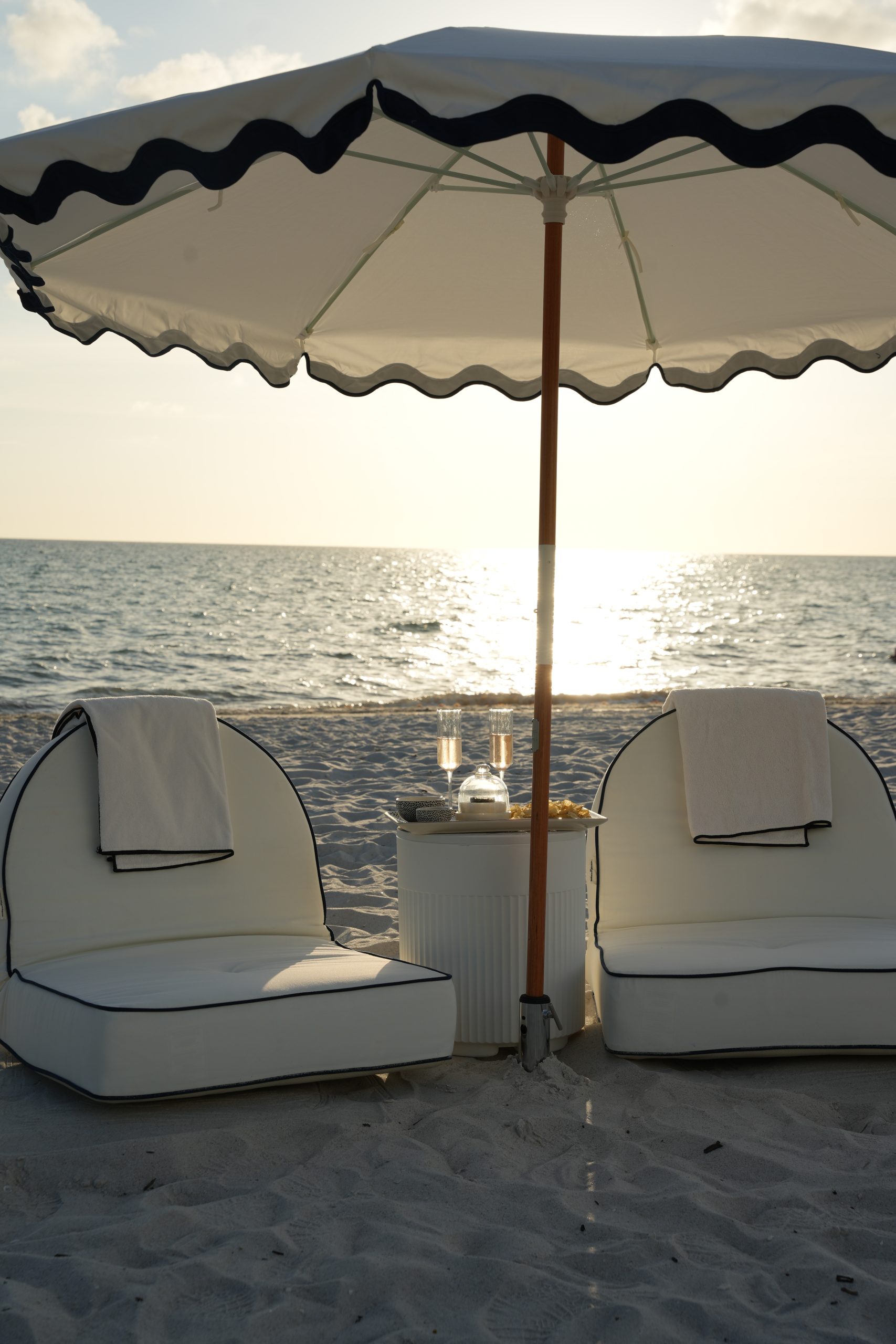
The most comfortable window on a Naples beach is the last three hours before sunset. The sand has come off peak heat, the onshore Gulf breeze is usually up, and the low sun angle means an angled umbrella actually covers you. The EPA identifies 10 a.m. to 4 p.m. as the strongest sun, so a block starting after four avoids the worst of it entirely.
What actually makes a beach comfortable
Three variables decide it, and air temperature is not the first of them. Real shade, moving air and the time of day do almost all the work. A thermometer reading tells you very little about whether an afternoon on the sand will be pleasant.
The reason is that a beach is an open radiative environment. You are absorbing direct sun, reflected sun off pale sand, and reflected sun off water, all at once. Shade removes the first and part of the second. Breeze carries away the heat your body is shedding. Timing changes the intensity of all of it.
Get those three right and a July afternoon is comfortable. Get them wrong and a mild March day is not. This is the entire reason a styled setup is a comfort product rather than a decoration one.
Real shade versus nominal shade
An umbrella only shades you if it is angled at the sun, and the sun moves. A shade structure planted straight up at one o'clock is shading a patch of empty sand by three, while everyone who paid for it sits in the light.
Angling is the difference between shade you sit in and shade you look at. Across a long afternoon the angle needs changing more than once, because the sun tracks west and drops. A cabana holds usable shade across a moving sun better than a single umbrella, which is why we use them for longer blocks and larger groups.
Seating placement matters as much as the shade itself. Chairs positioned for where the shadow is at setup time are chairs in the sun an hour later. We place both together, and reposition rather than leaving it.
The breeze does more than the temperature
The onshore Gulf breeze typically builds through the afternoon, and it changes perceived comfort far more than a few degrees of air temperature. Moving air carries away the heat your body is shedding; still air lets it sit against you.
Two practical consequences. First, seating faces into the breeze rather than away from it, which sounds trivial and is not. Second, shade plus moving air is the combination that works. Either alone is noticeably worse: shade in still air is stuffy, breeze in full sun is just fast-moving sunburn.
The breeze also masks how much water you are losing, because it evaporates sweat before you register it. That is a real effect and it is the reason a cooler packed with ice and water is standard on every setup rather than an upgrade.
Why reflected light is the part people underestimate
You are not only being lit from above. Pale sand and open water both reflect a substantial amount of light back upward, which is why people burn in places they never burn anywhere else: under the chin, the underside of the nose, the backs of the knees.
It also explains the most common complaint about beach shade, which is that people sit under an umbrella all afternoon and still burn. The umbrella handles the direct component. It does very little about the reflected one, and no umbrella ever will.
The practical answer is that shade reduces exposure rather than eliminating it, so sunscreen is not optional under an umbrella. Federal guidance treats shade, clothing, sunglasses and sunscreen as a combined set rather than alternatives[2], and on a beach specifically that is the right way to read it.
It is also an argument for a deeper shade structure over a shallow one. A cabana blocks more of the low-angle reflected light in the late afternoon than an umbrella does, which is exactly when the sun is coming in sideways.
The coolest window is not the middle of the day
The instinct is to go early to beat the heat. The last three hours before sunset are more comfortable. The sand has come off peak temperature, the breeze is usually up, and the sun angle is low enough that shade covers people rather than the ground beside them.
- Late morning: cooler air, but a high sun angle and sand that is still heating.
- Midday: peak sun angle, peak sand temperature, worst shade geometry.
- Last three hours before sunset: breeze up, sun low, sand cooling. The window.
- After sunset: cools quickly. A light layer is worth having.
Sunset in Naples runs from 5:40 p.m. in December to 8:22 p.m. in late June[4], so that window sits at a very different clock time depending on the month. The detail is in our guide to timing a setup to the sunset.
What the UV index actually tells you
The EPA UV Index scale runs 1 to 11+, and southwest Florida sits in the upper half of it for much of the year.[1] The categories are worth knowing because they change what a reasonable block length is rather than only what sunscreen to use.
- 0 to 2, green: low risk for the average person.
- 3 to 5, yellow: moderate risk from unprotected exposure.
- 6 to 7, orange: high risk.
- 8 to 10, red: very high risk.
- 11 or more, purple: extreme risk.
The federal guidance is consistent across agencies: the sun is strongest between 10 a.m. and 4 p.m., and the recommendation is to reduce time in the sun in that window, seek shade, and wear protective clothing and UV-blocking sunglasses.[2] A block that starts after four sidesteps the strongest part of the day without giving up any of the good light.
Sunscreen, and the two triggers people miss
CDC sun safety guidance is broad-spectrum sunscreen at SPF 15 or higher, applied before going outside, then reapplied after two hours and after swimming, sweating or towelling off.[3]
Two of those reapplication triggers get missed almost universally on a beach. Towelling off removes sunscreen, and people rarely account for it. And the breeze evaporates sweat before anyone notices they are sweating, so the two-hour clock quietly becomes a four-hour one.
The workable version is a timer rather than a judgement call. It matters more for a group, where nobody is monitoring anybody, and more again for children. What is worth bringing and what is already on the sand is in what to bring to a beach setup.
Hydration, and why the cooler is standard
Every setup arrives with a cooler packed with ice and water. That is not a hospitality detail, it is a comfort one, and it exists because heat on open sand with a breeze is genuinely deceptive.
The mechanism is the same one that makes the breeze pleasant. Evaporation cools you efficiently, and efficient evaporation means you lose water without the usual feedback of feeling sweaty. People drink to thirst, and on a breezy beach thirst arrives late.
Drink before you feel like it, and keep the cooler in the shade rather than beside it. Ice in direct sun on a July afternoon is water by four o'clock.
Sand temperature, the variable nobody plans for
Pale sand reflects a great deal of light and still gets hot enough to be genuinely unpleasant underfoot. In summer it stays warm well into the evening, long after the air has started to cool.
The practical effects are all small and all annoying. The walk from parking is barefoot for most people and becomes a problem in July. Bags left on open sand get hot. And children, who are closer to it and less stoic about it, notice first.
Something on your feet for the walk solves most of it. Choosing an access point with a shorter carry solves the rest, which is one reason 3rd Avenue South is our recommendation for groups. The comparison is in the best beaches in Naples for a setup.
Planning a block length that people can actually sit through
Comfort sets the ceiling on block length, not enthusiasm. A group will stay as long as it is pleasant and not a minute longer, regardless of what was booked.
- Young children: about two hours, timed late in the day.
- Adult groups with real shade: three to four hours comfortably.
- Older guests: shorter, in the evening window, with continuous shade.
- Two people at sunset: 90 minutes is the classic and it is usually right.
The variable that most changes those numbers is whether the shade is continuous or intermittent. Shade that moves off through the afternoon converts a four-hour group into a two-hour one without anybody deciding to leave early.
Setting up for a group that will not stay together
People do not sit still for four hours, and a setup that assumes they will is uncomfortable within one. In any group there are people in the water, people in deep shade, and people moving between the two.
That circulation is the thing to design for. Shade deep enough that the people who want it are genuinely covered rather than half in it. A clear centre to come back to, so the group does not fragment into pairs. And enough room that someone walking to the water is not stepping over four people to get there.
Wet people returning to shade is its own small consideration. Somewhere for towels that is not the sand, and seating that tolerates being sat on wet, both of which are standard rather than special.
None of this is visible in a photograph of a setup. All of it is the difference between a group that stays four hours and one that quietly starts checking phones at ninety minutes.
Children, older guests and everyone else
The comfortable window is the same for everyone. The tolerance either side of it is not.
Children heat faster, burn faster, and say so sooner. A long-sleeved swim layer does more reliable work than reapplying sunscreen to a moving target, and a block timed into the late afternoon avoids the strongest sun entirely[1]. Two hours is a realistic ceiling regardless of how good the setup is.
Older guests want continuous shade rather than shade that migrates, seating with proper backs, and the shortest possible walk from parking. Any one of those being wrong shortens the visit; all three being right frequently extends it past what anyone expected.
Everyone in between is genuinely flexible, which is why the group is usually planned around whoever has the narrowest tolerance rather than the average. There is more on this in beach birthday ideas in Naples.
Summer storms, and reading them correctly
The southwest Florida summer pattern is its own kind of reliable. Afternoon convection builds inland through the heat of the day and frequently clears toward the coast by early evening. A menacing three o'clock genuinely does not mean a lost seven-thirty.
This is the main reason we would rather talk through conditions on the day than cancel on a morning forecast. It is also an argument for the evening window on its own terms: a block that starts at five is a block that starts after the convection has usually peaked.
Overcast is not the enemy people assume either. Low cloud gives soft, even, flattering light with no harsh shadows, and it is considerably more comfortable than full sun. It is a worse sunset and a better afternoon.
What changes in the shoulder seasons
Heat management is a summer problem. Timing is a year-round one. The comfortable window moves substantially with the calendar, and the reason is the sunset rather than the temperature.
In winter, sunset is at 5:40 p.m. around the December solstice[4], so the last three hours before it are mid-afternoon. Heat is not the constraint; the constraint is that the whole evening compresses, and a light layer matters more once the sun is down.
In spring, particularly March through May, the combination is at its best: sunset late enough for a proper evening block, temperatures below peak summer, and clearer skies than the storm season. It is also the busiest window in Naples, so those weekends book earliest.
Autumn is quiet and, for the first half of it, still inside sea turtle nesting season[5].
Shade for groups versus shade for two
The shade problem is different at different group sizes, and the solution is not simply more umbrellas.
For two people, a single well-angled umbrella tracks the sun easily and covers both chairs. The setup is compact enough that repositioning is quick and the geometry stays simple all afternoon.
For a group, scattered umbrellas fragment the party. People end up in twos and threes chasing separate patches of shadow, which is the opposite of what a celebration is for. A cabana or a coordinated arrangement keeps the group in one place and one frame, which matters for the photographs as much as for the comfort.
That is why the group setups are arranged inward rather than as a row facing the water, and why the headcount at booking needs to be the real number. The packages are on the beach setup packages in Naples page.
The evening deadline in nesting season
From roughly May through October the beaches are active sea turtle nesting habitat, and nothing should be left on the sand overnight.[5] Nests incubate around 60 days, so hatchlings emerge into the autumn.
Collier County guidance is that beach furniture comes off each night, with penalties for furniture left after 9:30 p.m. under the Land Development Code. We could not load the county's page directly to quote it verbatim, so treat the exact time as guidance to confirm rather than a quoted code section.
For a block timed into the comfortable evening window this never binds, because the light goes before the deadline does. It matters if you are assembling your own setup and planning to stay late, in which case the removal lands on you at the end of the evening. Cleanup and removal are included on every setup we do.
The rules worth knowing before you plan the day
Two restrictions catch out celebration bookings specifically. Alcohol without written approval is prohibited on City of Naples property, and glass is prohibited outright.[6]
Neither has much to do with heat, but both intersect with the practical planning of a long afternoon, particularly the cold-drinks question. Plan a toast for a restaurant either side of the block, or seek approval in advance. Nothing glass, on a surface people walk barefoot across.
Mention the occasion when you check your date and we will tell you plainly what works at the access point you have in mind. Other occasions are on the beach celebrations page.
The whole strategy in four lines
Everything above condenses to this.
- Time it late. The last three hours before sunset, avoiding the 10 a.m. to 4 p.m. window the EPA identifies as strongest.[1]
- Shade that is angled and repositioned, not planted and abandoned.
- Face the breeze, and keep shade and moving air together rather than choosing one.
- Drink before you are thirsty, because the breeze hides the loss.
Three of those four are ours to handle. The fourth is a cooler that is already packed and already in the shade when you arrive. More planning guides are in the journal, and when you have a date, request your date and we will time the block into the comfortable window for it.

Andrea
Founder, Make My Beach Day · Naples, Florida
Andrea founded Make My Beach Day and has been styling and setting up beach days on the Naples coastline since the company started. The timings in this guide come from running setups across every month of the year on 3rd Avenue South, 5th Avenue South and Via Miramar, checked against published astronomical data rather than memory. Talk to Andrea about your date.
Andrea
Founder, Make My Beach Day
Tap a question to ask
References
- US Environmental Protection Agency. UV Index Scale. The 1 to 11+ UV Index scale and its exposure categories.
- US Environmental Protection Agency. Ultraviolet (UV) Radiation and Sun Exposure. Federal guidance on UV exposure and sun protection.
- Centers for Disease Control and Prevention. Sun Safety Facts. CDC guidance on midday sun, shade, clothing and sunscreen.
- US Naval Observatory, Astronomical Applications Department. Sun and Moon Rise/Set Table for One Year. Sunset and twilight times computed for Naples, Florida (26.14°N, 81.79°W).
- Florida Fish and Wildlife Conservation Commission. Sea turtles and beach activities. State guidance on beach activity during marine turtle nesting season.
- City of Naples. Beach Patrol. City of Naples beach rules and enforcement.
Ready to book your beach day?
Tell us the date and we will time the block into the comfortable window.
Book your beach day